
Category: Gentle Movement

  • Wall Sits and Wonder: A Gentle Movement Snack You Can Do Anywhere

    Wall Sits and Wonder: A Gentle Movement Snack You Can Do Anywhere

    Here is the real reason you keep skipping workouts: they feel like an event. Change your clothes, find 45 minutes, drive somewhere, come home wrecked. Your brain does the math and quietly opts out.

    So stop scheduling events. Start eating snacks.

    A movement snack is a tiny burst of activity, 30 seconds to two minutes, that you do in your regular clothes, in your kitchen, between the things you already do. No sweat. No gear. No shame if you miss one. The point isn’t to torch calories. The point is to keep your body awake and your mind steady, over and over, all day long.

    Why snacks beat feasts

    Consistency wins. A person who moves for one honest minute, eight times a day, is building a stronger relationship with their body than someone who plans a big workout and does it twice a month. Tiny reps are easy to repeat. Easy to repeat means they stick. That’s the whole game.

    Four beginner moves, zero equipment

    Pick one to start. You do not need all four today.

    1. The wall sit

    Stand with your back against a wall. Walk your feet out and slide down until your knees are bent, somewhere between a light sit and a full 90 degrees. Go only as low as feels good. Hold for 15 to 30 seconds. Breathe.

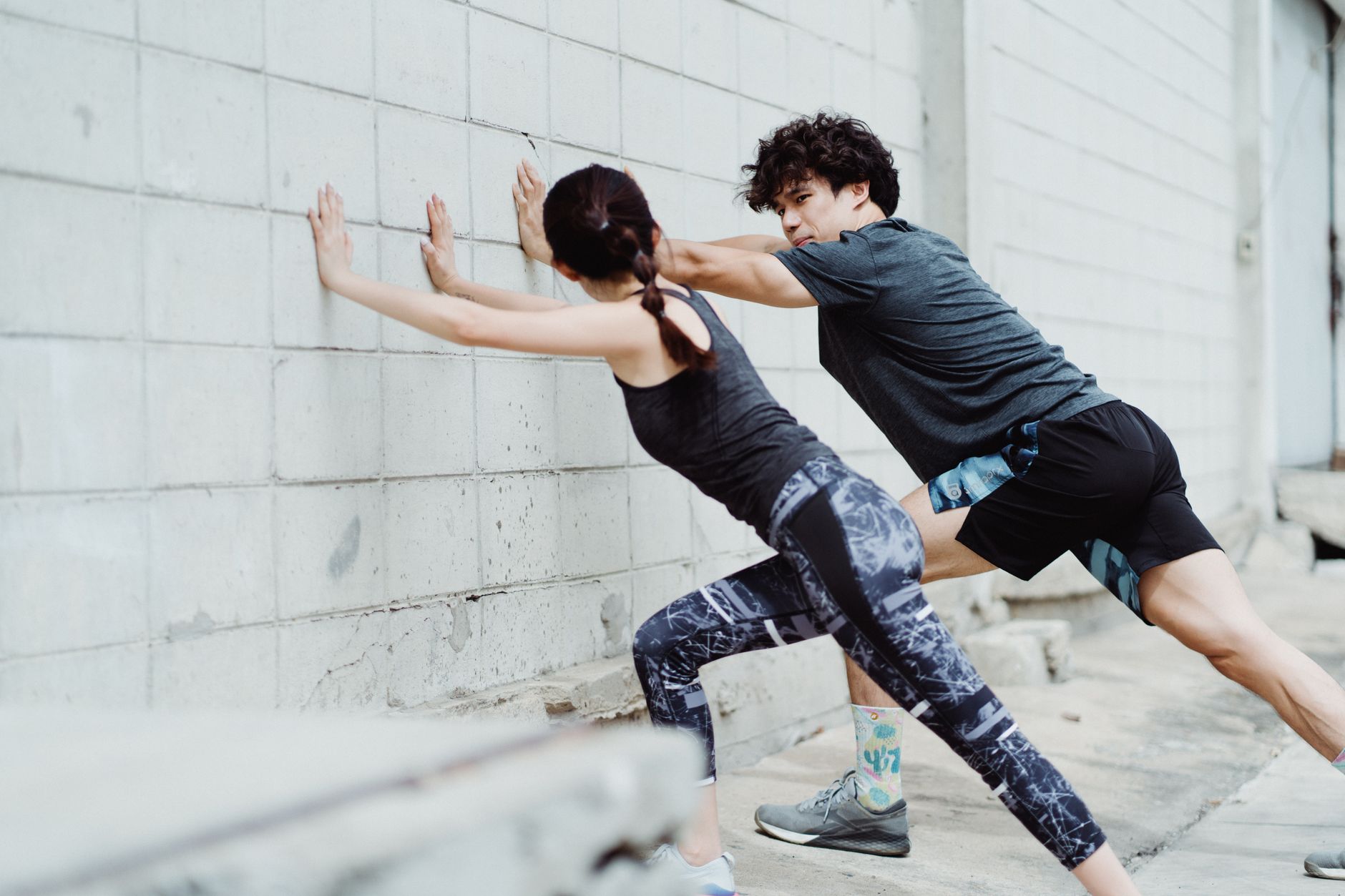
    2. Counter push-ups

    Place your hands on the edge of a sturdy counter, walk your feet back, and lower your chest toward the counter, then press away. Ten slow reps. The higher your hands, the easier it is, so start high.

    3. Sit-to-stands

    Sit at the front of a chair. Stand up without using your hands. Sit back down with control. That’s one. Do five to ten. This is one of the most useful movements you can train because you already do it a hundred times a day.

    4. Calf raises

    Stand tall, rise up onto the balls of your feet, hold for a beat, lower slowly. Hold the counter for balance if you need it. Do ten to fifteen. Great while you’re already standing around waiting for something.

    Pair the move with a line that means something

    Here’s where the mind-body part earns its keep. When you move, your brain is paying attention. That’s a good moment to hand it a thought worth keeping.

    Match one short affirmation to each move and say it, out loud or in your head, while you do the reps. Not because the words are magic. Because you’re teaching your nervous system to link effort with a feeling of capability instead of dread.

    • Wall sit: “I can hold steady when things get hard.”
    • Counter push-ups: “I create space by pushing gently, not forcing.”
    • Sit-to-stands: “I rise on my own strength.”
    • Calf raises: “I lift myself, a little at a time.”

    Keep them true and simple. A line you actually believe beats a grand one you roll your eyes at.

    Stack it onto something you already do

    Willpower is unreliable. Triggers are not. The fastest way to make a movement snack automatic is to bolt it onto a habit that already happens without you thinking.

    The kettle is perfect. You flip it on, you’ve got 90 seconds of dead time, and you’re already standing in the kitchen.

    1. Pick your anchor. Kettle boiling. Coffee brewing. Microwave running. Ad break. Toothbrush charging.
    2. Attach one move. “While the kettle boils, I do a wall sit.” Say it as a sentence. That sentence is the plan.
    3. Say your line while you move. One move, one affirmation, done before the water’s hot.
    4. Let the anchor remind you. Soon the sound of the kettle will pull you toward the wall without a single reminder app.

    Do this and you’ll rack up several movement snacks a day without ever “finding time.” The time was already there. You just filled it.

    You don’t rise to the level of your goals. You fall to the level of your smallest, most repeatable habit.

    A realistic first week

    Choose one move and one anchor. That’s it. Wall sit while the kettle boils, say your line, move on with your morning. When it feels automatic, add a second pairing. Build slowly on purpose, because slow is what lasts.

    If you want a gentle framework to build these small habits into a daily rhythm, the free 7-Day Mind-Body Reset at manifestedfit.com walks you through pairing tiny movements with mindset work, one day at a time.

    You don’t need a better plan. You need a smaller one you’ll actually do. Flip the kettle. Face the wall. Say your line. That’s a whole practice, hiding inside 90 seconds you were going to waste anyway.

  • The Stress Reset You Can Do in a Doorway

    The Stress Reset You Can Do in a Doorway

    Stress doesn’t just live in your head. It parks in your body. Tight chest, hunched shoulders, shallow breath. And here’s the real reason a quick mental pep talk rarely fixes it: your body is still holding the alarm. You can’t think your way out of a clenched chest. You have to move it out.

    That’s why a doorway works so well. You already walk through a dozen of them a day. Each one is a built-in cue to stop, open up, and breathe. Ninety seconds. No mat, no app, no changing clothes.

    Why the doorway, specifically

    When you’re stressed, you round forward. Shoulders curl in, chest collapses, breath gets tiny and fast. That posture literally signals “threat” to your nervous system, and your nervous system answers by staying revved.

    A doorway lets you do the exact opposite. You open the chest, lengthen the front of your body, and reverse the stress posture. Pair that with slow, controlled breathing and you give your body physical proof that the danger is over. That’s the whole trick. Position plus breath.

    The doorway stress reset, step by step

    Do this between tasks, before a hard call, or the second you notice your jaw is tight.

    1. Stand in the doorway. Feet under your hips. Bring your forearms up to the door frame on each side, elbows around shoulder height.
    2. Step one foot forward and let your chest gently press through the opening. You should feel a light stretch across the front of your shoulders and chest. Not a strain. Just an open.
    3. Hold and drop your shoulders away from your ears. Let your head float back to neutral. Stay here for the breathing.
    4. Box breathe. Inhale through your nose for 4 counts. Hold for 4. Exhale slowly for 4. Hold empty for 4. That’s one round.
    5. Do 4 rounds. That’s roughly 64 seconds of breathing plus the stretch. Under two minutes total.
    6. Step back, shake out your hands, and roll your shoulders once. Then move on.

    Why box breathing and not just “deep breaths”

    Vague “take a deep breath” advice fails because most people just take one big gulp and go right back to shallow. Box breathing gives you a structure. The counting occupies your mind, the long exhale is the part that actually calms you, and the even rhythm keeps you from hyperventilating. The count is the point. It’s a job for your busy brain so the rest of you can settle.

    Reset between tasks, not just during meltdowns

    Here’s what most people miss: the reset works best as maintenance, not rescue. If you only do it when you’re already fried, you’re fighting uphill. Build it into the seams of your day instead.

    • Between meetings. Before you open the next tab, hit a doorway.
    • Task switching. Finished one thing, dreading the next? Reset in the doorway on your way.
    • Coming home. Use the front door as a hard line between work-you and home-you.
    • Before you eat. Four rounds of box breathing before a meal helps you actually taste it.

    Think of it as closing one tab before opening another. You wouldn’t run 40 browser tabs and expect your laptop to stay fast. Your brain’s the same. The doorway reset is you hitting close.

    Make it stick

    The reason this beats fancier routines is friction. Almost zero. But you still have to trigger it, so tie it to something you already do.

    • Pick one doorway you pass often and make it “the reset door.” A sticky dot on the frame works as a reminder.
    • Stack it onto an existing habit: every time you refill your water, reset on the way back.
    • Lower the bar. Even two rounds counts. Done small beats skipped perfect.

    Stress management isn’t one big event. It’s a hundred small releases before the tension gets a chance to pile up.

    You don’t need more time. You need a place and a cue. The doorway gives you both.

    If you want a simple structure to build these micro-resets into a full day of small mind-body habits, grab the free 7-Day Mind-Body Reset at manifestedfit.com. It’s a gentle, no-pressure way to practice this stuff until it’s automatic.

    Next time you walk through a door, don’t just pass through it. Use it. Chest open, four slow breaths, and move on lighter.

  • A Walk Counts. Here’s Why It Counts More Than You Think.

    A Walk Counts. Here’s Why It Counts More Than You Think.

    Somewhere along the way, we decided that movement only “counts” if it leaves us dripping, gasping, and questioning our life choices on a mat. If it didn’t hurt, did it even happen? (Yes. Yes, it did.) So let me be the friend who leans over the fence and whispers the good news: a walk counts. It counts a lot. It counts more than the algorithm wants you to believe.

    A walk is the golden retriever of exercise. Loyal, endlessly happy to see you, thrilled to go out no matter the weather, and asking for absolutely nothing fancy in return. No membership. No special shoes. No coordination required beyond “left foot, right foot, repeat.”

    Why a Simple Walk Punches Above Its Weight

    Here’s the thing nobody puts on a motivational poster: the movement you actually do beats the movement you fantasize about. A 20-minute walk you take today is worth infinitely more than the perfect hour-long workout you keep rescheduling for “when things calm down.” (Spoiler: things do not calm down. Things are gremlins. They multiply.)

    Walking is quietly brilliant because it stacks little wins:

    • It lifts the mood needle. Fresh air, a change of scenery, and rhythm have a way of shaking the mental snow globe until things settle clearer. Many people find a walk is where their best thoughts sneak up on them.
    • It’s absurdly repeatable. Consistency is the whole game, and walking is the easiest habit to actually keep. Low effort to start, low soreness afterward, low chance of you inventing an excuse.
    • It doesn’t demand a costume change. You can walk in whatever you’re wearing right now. Slippers to the mailbox count. I don’t make the rules — actually, today I do, and I say they count.

    Let It Be Enough

    This is the part I want to tattoo on the inside of your eyelids: the walk does not need to become something else to be worthy. It doesn’t have to “turn into” a run. It doesn’t need to hit 10,000 steps to earn its keep. It doesn’t need a heart-rate zone or a personal best.

    A walk that happened beats a marathon that didn’t.

    When we let small movement be enough, a funny thing happens — we do more of it. The pressure to make every session epic is exactly what keeps us on the couch, paralyzed by the size of the mountain. Walking removes the mountain. It hands you a friendly little hill instead, and off you toddle.

    How to Habit-Stack Your Daily Walk

    The secret to making a walk stick isn’t willpower — it’s velcro. You attach it to something you already do, so it rides along on the back of an existing habit. This is habit-stacking, and it’s gloriously lazy in the best way.

    1. Anchor it to a thing you never skip. “After my morning coffee, I lace up and walk to the end of the street.” The coffee is the trigger. Your brain already loves coffee, so it’ll drag the walk along for the ride.
    2. Start comically small. Five minutes. Around the block. To the corner and back. If it feels too easy to be worth it, you’ve done it exactly right. Tiny habits survive; heroic ones burn out by Thursday.
    3. Pair it with something delicious. A podcast you only allow yourself on walks. A playlist. A phone call to your mum. Suddenly the walk isn’t a chore — it’s the ticket to the good stuff.
    4. Make the reward instant. Notice how you feel when you get back. Say it out loud: “Well, that was nice.” Your brain files that away and starts nudging you toward tomorrow’s walk on its own.

    A Gentle Word on “Real” Exercise

    If you love the sweaty stuff, wonderful, keep going. But if intense workouts feel like a wall you keep bouncing off, walking is a door left casually open. Movement is movement. Your body doesn’t have a snob switch that only activates above a certain intensity. It just likes to be used, regularly and kindly.

    And on the manifestation side of the house — walking is prime time for it. A little stroll is a moving meditation. Picture the day you want as your feet find their rhythm. Let the version of you you’re becoming take a walk with you. It’s remarkable how a decision made mid-walk feels clearer than one made while doom-scrolling.

    Your Tiny Assignment

    Today, take one walk. Any length. Attach it to something you already do. Let it be enough — genuinely, fully enough. Then do it again tomorrow, and watch the golden retriever of habits happily follow you into next week.

    If you’d like a little scaffolding to hang these small habits on, our free 7-Day Mind-Body Reset is a gentle place to start — no burpees, no pressure, just doable daily nudges toward feeling like yourself again.

    Now go on. Left foot, right foot, repeat. It counts. I promise it counts.

  • The 10-Minute Movement Routine Almost Anyone Can Stick To

    The 10-Minute Movement Routine Almost Anyone Can Stick To

    Let’s be honest about the great gym membership graveyard. You know the one u2014 that membership card gathering dust, that ambitious spin class you booked at 11pm feeling like a champion and cancelled at 6am feeling like a burrito. We’ve all been there. And here’s the plot twist nobody tells you: the problem was never you. The problem was the size of the ask.

    An hour-long workout you never do burns exactly zero calories and zero good vibes. A 10-minute routine you actually do? That one’s real. It exists. It moves your body and rewires your brain into someone who moves. Today we’re building that tiny, wildly doable habit together.

    Why 10 Minutes Beats an Unused Hour

    Here’s the math that changed my whole relationship with movement: a perfect plan you skip is worth less than a mediocre plan you keep. Ten minutes, done four or five times a week, quietly stacks up while your ambitious one-hour fantasy is still sitting on the couch eating your intentions.

    Small also means your brain doesn’t slam the panic button. An hour feels like a commitment worthy of a signed contract. Ten minutes feels likeu2026 the length of a good song and a stretch. Your inner drama llama has nothing to protest. And because it’s easy to say yes to, you build the one thing that actually matters long-term: the identity of a person who moves their body.

    Consistency is a snowball. It doesn’t care how big it starts u2014 it only cares that you keep rolling it.

    The 4 Beginner Moves

    No equipment, no floor-flailing, no coordination degree required. Do each one for a little over two minutes, or run through the whole set twice if you’re feeling zesty. Move at a pace that feels kind, not punishing.

    1. Marching in Place (2-3 minutes)

    This is your gentle engine warm-up. Stand tall, lift one knee, then the other, swinging your arms like you’re the friendliest parade in town. Go slow, then a touch quicker as you warm up. This wakes up your whole body without asking anything scary of it.

    2. Wall Push-Ups (2-3 minutes)

    Regular push-ups can feel like a betrayal of the human spirit, so we’re taking them vertical. Stand an arm’s length from a wall, place your palms on it at shoulder height, and gently bend your elbows to lean in, then push back. Easy on the arms, big on the confidence.

    3. Sit-to-Stands (2-3 minutes)

    Grab a sturdy chair. Sit down, stand up, sit down, stand up. That’s it. This is one of the most useful moves for real life u2014 it’s basically training for getting off the couch with grace for the rest of your days. Use your arms for a boost if you need to. No prizes for suffering here.

    4. Standing Side Reaches (1-2 minutes)

    Time to cool down like a graceful noodle. Reach one arm up and over to the side, feel the stretch along your ribs, then switch. Breathe deep. This is the part where you get to feel smug and lovely about what you just did.

    The Secret Sauce: Habit Stacking

    Willpower is a flaky friend. It shows up strong on Monday and ghosts you by Thursday. So instead of relying on it, we’re going to bolt your new routine onto something you already do without thinking. This is called habit stacking, and it’s basically hitching a ride on a habit that already has momentum.

    The formula is deliciously simple:

    • After I pour my morning coffee, I’ll march in place while it brews.
    • After I brush my teeth, I’ll do my wall push-ups.
    • Before I get in the shower, I’ll run through my four moves.
    • While my lunch reheats, I’ll do sit-to-stands.

    Notice how none of those require you to “find time” u2014 the time is already there, wrapped around a thing you do daily. You’re just filling the little gap with movement instead of scrolling.

    A Few Gentle Reminders

    1. Two minutes counts too. If ten feels like too much on a rough day, do what you can. Showing up beats showing off.
    2. Missed a day? No drama. Just start again. The habit isn’t broken u2014 it’s paused.
    3. Make it pleasant. Play a song you love. The routine sticks better when it feels like a treat, not a tax.

    Movement doesn’t have to be a grand transformation montage. It can just be ten minutes of showing your body a little love, stacked onto your morning coffee, done today and again tomorrow. That’s the whole trick.

    If you want a little structure to lean on while this habit takes root, come grab our free 7-Day Mind-Body Reset u2014 it’s a gentle nudge to help these tiny habits actually stick. Now go march around your kitchen. Your future self is already grinning.